
Lichens: The Fascinating Organisms Hiding in Plain Sight
What Are Lichens?
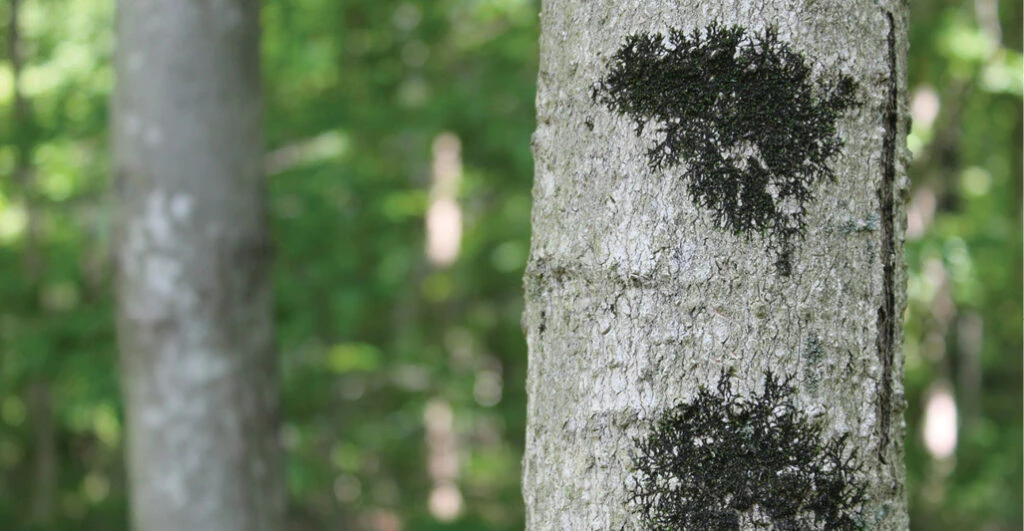
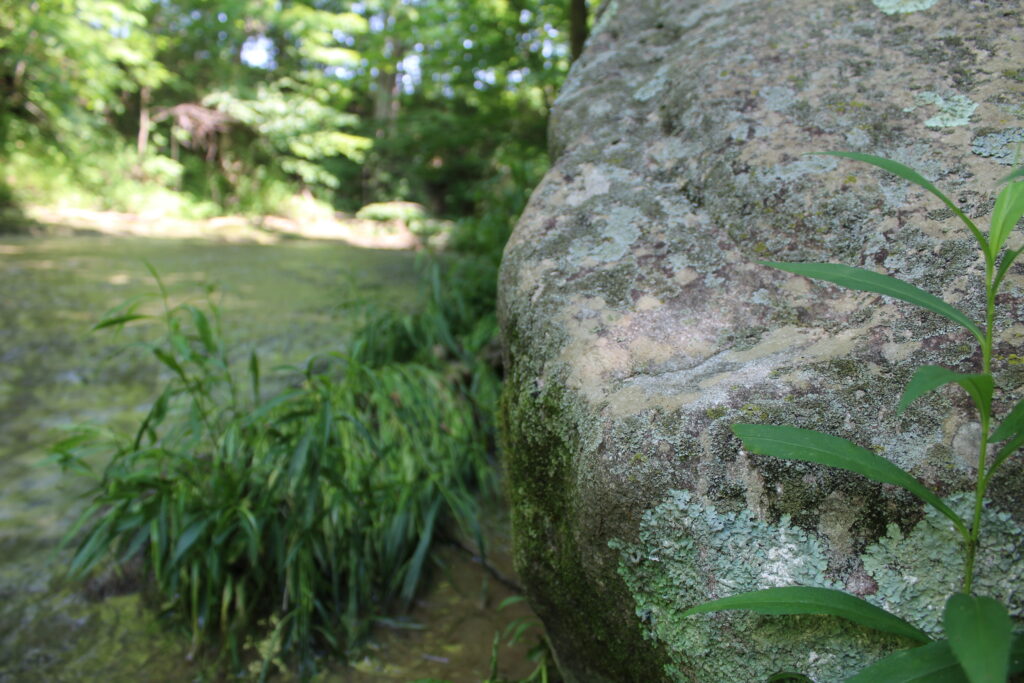
Lichens can be easily overlooked, but they are one of the more fascinating and widespread organisms that exist all around us. They grow in a wide range of habitats — damp crevices in rock walls, tree bark, city sidewalks, on decaying logs and even the landscaping stones in your front yard.
You’re guaranteed to find them almost anywhere on the planet. Lichens have been found to survive even in extreme environments such as simulated Mars-like conditions and in the vacuum and radiation of space. They’re tenacious organisms that deserve attention and appreciation!
A Partnership Like No Other
The global presence of lichens should be enough to create plenty of allure for this diminutive lifeform, but there’s another kicker — lichens aren’t comprised of just one organism: they’re made up of two, or sometimes even three. Lichens are a two-organism partnership between fungus and an algae (or cyanobacteria, sometimes both). In those other cases, it’s been discovered that certain lichens do have a third component in the form of a basidiomycete yeast. These organisms have learned to cooperate in unique ways over a long period of biological time, establishing miniature universes of cooperation that in turn provide structure and habitat for bacteria, non-lichen fungi, microscopic worms and even tardigrades (affectionately known as “water bears”). They seem unassuming until you peer through a magnifying lens and start witnessing things at a different level of scale.
Three Forms of Lichen Growth
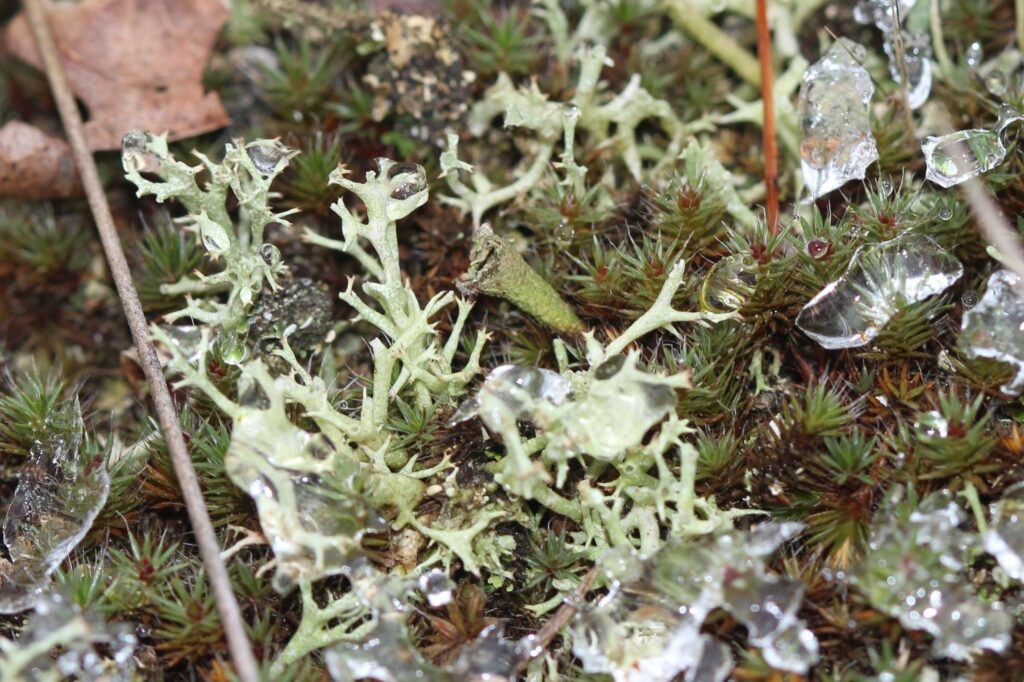
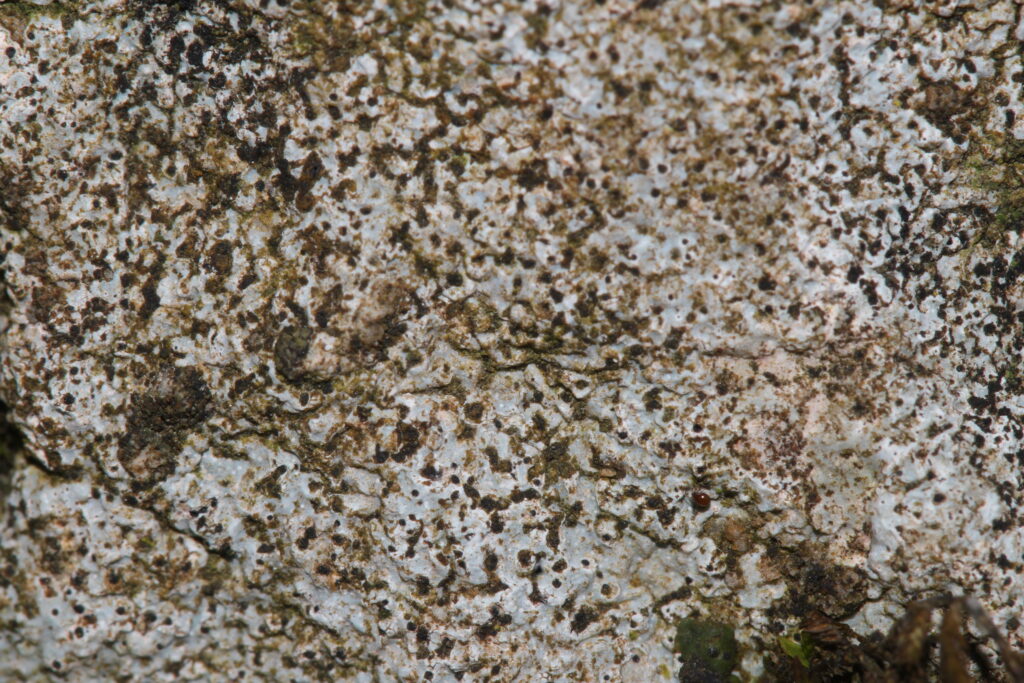
The whole of a lichen in its entirety, called the “thallus,” occurs in three possible growth forms: crustose, foliose and fruticose, depending on the group they belong to. Some are very leafy in appearance and easy to pick out from a distance, while others are small and hide very well, often appearing as no more than a lighter colored circle on tree bark, or tiny “pebbles” on the surface of rock. If you look up these terms online, you’ll find excellent examples of the diversity within each type! They also have a wide variety of fun common names. Mealy boulders? Fool’s gold dust? Flakey firedots? Curly biscuits? It’s hard not to get a chuckle thumbing through the average list of names for lichens.
Uncovering Indiana’s Lichens
Recently, surveys were conducted at several ACRES preserves in Huntington and Wabash Counties alongside Gerould Wilhelm of the Conservation Research Institute, in the Chicago area. Our understanding of where different groups and the species within them occur relies on collections made by scientists and many other passionate people, and since lichens are a very understudied group, there were no collections made for either county. To determine whether collections have been made, we look at the Consortium of Lichen Herbaria, which houses records from around the world. In other words, we had work to do!
Discoveries At ACRES Preserves
The ACRES preserves that were surveyed included Pehkokia Woods, Hanging Rock National Natural Landmark, Hathaway Preserve at Ross Run and Kokiwanee. At each property, we found species that had been collected only once before within the state, and several were first-ever collections altogether. Many uncommon in the Midwest rely heavily on high-quality habitat associated with the microclimates created by rock ledges, heavily dissected streamside banks and other spaces that feature topographic variation and limestone exposures.
Hathaway Preserve at Ross Run
A few species of interest at Hathaway included scarce taxa such as Bacidina delicata, Coppinsidea croatica, Lecanora thysanophora, Placynthium nigrum, Thelidium zwachkii, Verrucaria glaucovirens, Verrucaria tecta and really rare, growing among Climacium americanum moss patches, Scytinium lichenoides.
Hanging Rock National Natural Landmark
At Hanging Rock National Natural Landmark, we collected Bagliettoa calciseda and Verrucaria fayettensis, which are conservative to base-rich rock.
Kokiwanee
At Kokiwanee, we collected Verrucaria dolosa on a half-buried rock. Gerould had seen this only once before!
Pehkokia Woods
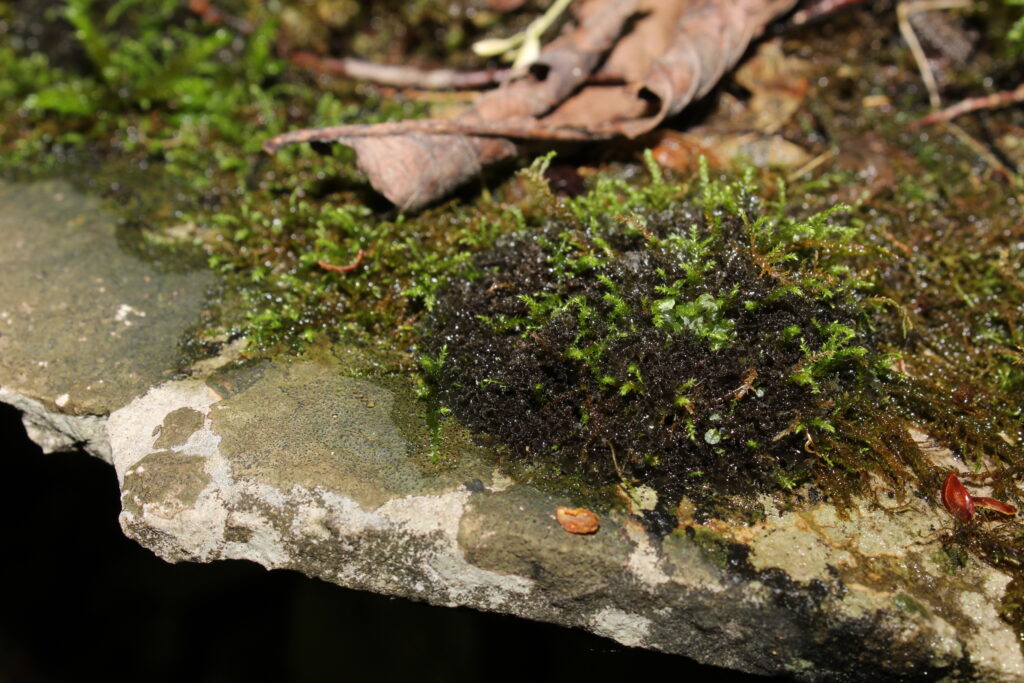
At Pehkokia Woods, six species from the Cladoniae group were all found on a single old piece of long-discarded roof wood, including Cladonia coniocraea, Cladonia fimbriata, Cladonia rei and two species still to be determined. Coppinsidea croatica was found on one of the Sugar Maples and was previously uncollected for northeast Indiana.
Some species are truly unique. We noticed some funny little yellow spots growing only on pine sap and decided to take a sample. It wound up being Zythia resinae, a pine sap obligate, which means it can only grow directly on the sap of members of the pine tree family. This is the second time it’s been collected for the state!
Begin Your Lichen Journey
Some of the species can be identified with a guide and a jeweler’s loupe; others require more intensive study with a microscope and even chemical application. Lichens present engagement for everyone, whether you’re a beginner or a seasoned botanist.
All in all, lichens are a fun element of our natural areas that usually get overlooked but present a lot of potential for enjoyment and discovery. Grab a hand lens, head out to your favorite local nature preserve and try to find a few for yourself.
Leave A Reply